
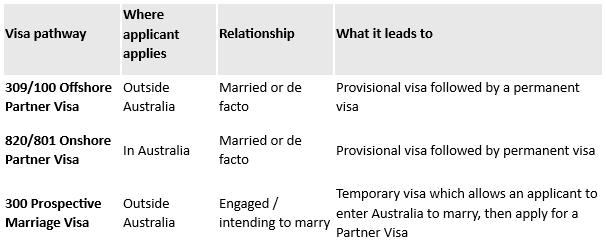
If you are in a relationship with an Australian citizen, Australian permanent resident or eligible New Zealand citizen, there are several visa pathways that may allow you to live together in Australia. The appropriate pathway will depend on factors such as where the main applicant is located when they are submitting the application, the nature of the relationship, and whether the couple is married, in a de facto relationship, or planning to marry.
The main partner-related visa pathways are:
Subclass 309/100 – Offshore Partner Visa
Subclass 820/801 – Onshore Partner Visa
Subclass 300 – Prospective Marriage Visa
While these visas all relate to partners and prospective spouses, they have different eligibility requirements and application processes.
At a glance: Australian partner visa pathways
What does “provisional” mean?
The Subclass 309 and 820 are provisional Partner Visas, meaning they are the temporary stage of the Partner Visa pathway. While holding a provisional visa, you can generally live, work and study in Australia while progressing towards the permanent stage of your visa.
You generally become eligible for consideration for the permanent visas:
Under the offshore stream - Subclass 100 – 2 years after a decision is made on the 309 visa;
Under the onshore stream – Subclass 801 – 2 years after the date you lodged the 820 visa.
At that stage, you will generally need to provide further evidence demonstrating that your relationship with your partner is continuing and that you still meet the requirements for the permanent visa. There is however no additional Visa Application Charge when applying for this. In certain circumstances, the permanent visa may be granted even where the relationship has ended or other circumstances have changed. Learn more about the circumstances where the permanent Partner Visa may still be granted.
Let's look at each pathway in more detail.
Subclass 309/100 – Offshore Partner Visa
The Subclass 309/100 Partner Visa is generally used when the applicant is outside Australia when they apply. The applicant must be the spouse or de facto partner of an Australian citizen, Australian permanent resident or eligible New Zealand citizen.
Subclass 309 – Temporary Partner Visa
The Subclass 309 is the temporary stage of the offshore partner visa pathway.
If granted, it allows the applicant to enter and remain in Australia while their permanent partner visa application is considered.
Applicants generally need to demonstrate that their relationship is genuine and continuing and meet the relevant visa requirements.
Subclass 100 – Permanent Partner Visa
The Subclass 100 is the permanent stage of the offshore partner visa pathway.
The Department will generally assess the couple's circumstances again before the permanent visa is granted, including whether the relationship continues to meet the relevant requirements.
Who might consider the 309/100 pathway?
This pathway may be relevant where:
The applicant is outside Australia when applying.
The applicant is married to or in a de facto relationship with their Australian partner.
The couple wants to use an offshore partner visa pathway rather than an onshore application.
Subclass 820/801 – Onshore Partner Visa
The Subclass 820/801 Partner Visa is generally used when the applicant is in Australia when they apply. Like the 309/100 pathway, it consists of a temporary visa followed by a permanent visa.
However, under the 820 an applicant can wait for the grant of the visa onshore. In most cases the applicant will receive a Bridging Visa A (BVA) when they apply for the visa. The BVA will become effective when the visa the applicant held at the time of lodgement expires. The BVA comes with full work rights when applying under this visa stream. The BVA will not have a specific expiry date, instead it stays in place until a decision is made on the 820 or the application is withdrawn. The BVA does not come with travel rights, however, applicants do have the ability to apply for a Bridging Visa B which allows them to travel for a specified period.
Not all applicants are eligible to receive a Bridging Visa A, it is important to consult with a professional to ensure this will apply to you.
Subclass 820 – Temporary Partner Visa
The Subclass 820 is the temporary stage of the onshore partner visa pathway.
The applicant must generally be in Australia when the application is made and must meet the relevant relationship and visa requirements.
Depending on the applicant's circumstances and current visa conditions, there may also be important considerations about their ability to remain in Australia while the application is processed.
Subclass 801 – Permanent Partner Visa
The Subclass 801 is the permanent stage of the onshore partner visa pathway.
As with the Subclass 100, the Department will generally assess whether the relationship continues to meet the relevant requirements before the permanent visa is granted.
Who might consider the 820/801 pathway?
This pathway may be relevant where:
The applicant is in Australia when applying.
The applicant is married to or in a de facto relationship with their Australian partner.
The applicant's current visa and circumstances allow them to make a valid onshore application.
Important: Not every person in Australia can simply apply for a Partner Visa. Visa conditions, previous visa history and other circumstances can affect whether an onshore application is possible.
Subclass 300 – Prospective Marriage Visa
The Subclass 300 Prospective Marriage Visa is different from the 309/100 and 820/801 pathways because it is designed for couples who intend to marry, rather than couples who are already married or in a qualifying de facto relationship. It is sometimes referred to as the Fiancé(e) Visa.
The visa allows the applicant to travel to and remain in Australia for the relevant visa period (9 to 15 months) and marry their prospective spouse. After marriage, the applicant may then be able to apply for a Partner Visa, such as the Subclass 820/801 pathway, subject to meeting the applicable requirements.
Who might consider the Subclass 300?
This pathway may be relevant where:
The applicant is outside Australia however; the applicant and sponsor have met in person.
The couple intends to marry.
They do not currently meet the requirements for a Partner Visa as a married or de facto couple.
They want the prospective spouse to come to Australia to marry.
Relationship evidence for the Subclass 300
The relationship evidence required for a Subclass 300 Prospective Marriage Visa is generally different from the more extensive relationship evidence required for a Partner Visa. Rather than needing to demonstrate the relationship across the same range of financial, household, social and commitment aspects, the Subclass 300 focuses on whether the couple have met in person, know each other personally, and genuinely intend to marry and live together as spouses.
Importantly, the couple must have met in person since each person turned 18. Communication through phone calls, messages or the internet does not satisfy the requirement to have met in person. The couple must also be known to each other personally, with the nature and development of their relationship being relevant to this assessment.
Evidence of communication and contact can therefore be useful in demonstrating how the relationship developed and the extent to which the couple know each other. The circumstances of the relationship, including cultural or traditional considerations, may also be relevant.
What happens after the Subclass 300?
If the couple chooses to use the Subclass 300 as a pathway to an onshore Partner Visa (Subclass 820/801), they will need to take the appropriate steps to establish their life together as a married couple following the marriage. When applying for the Subclass 820, they must meet the relevant Partner Visa criteria and provide evidence of their relationship at that stage.
This can include evidence covering the financial aspects of the relationship, the nature of the household, the social aspects of the relationship, the nature of their mutual commitment, and the development of their relationship. The evidence required for the 820 application is therefore more comprehensive than the evidence used to demonstrate the relationship for the initial Subclass 300 application.
Want to understand the relationship evidence required for a Subclass 300 in more detail? Read our guide to Subclass 300 relationship evidence.
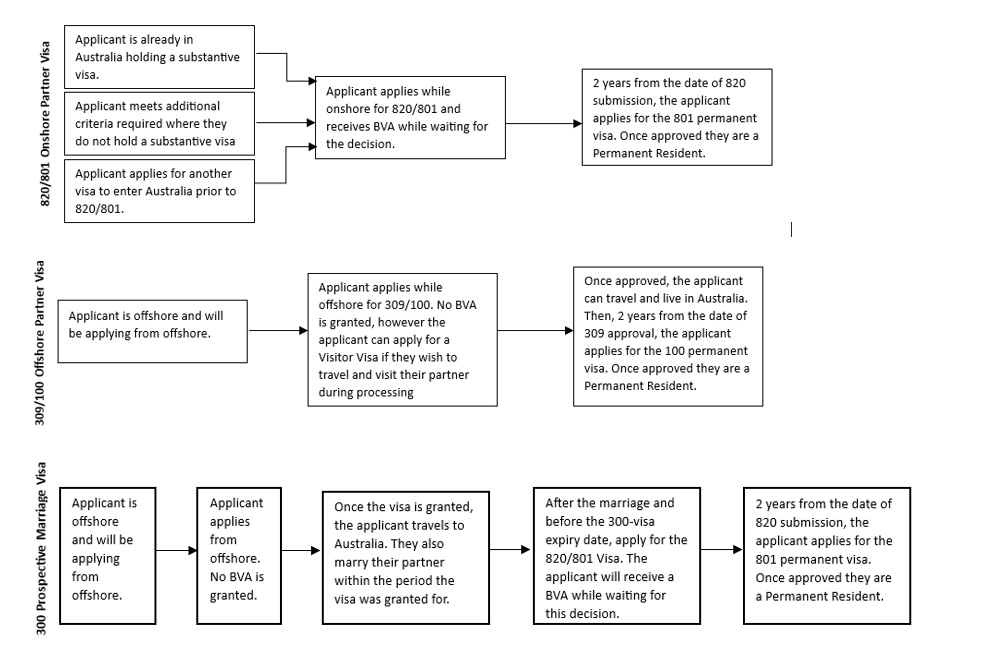
What does each visa pathway look like?
A very simplified version of each pathway is below. This will not be the same for every applicant.
Which Partner Visa is right for you?
There is no single Partner Visa pathway that is suitable for every couple. The appropriate pathway can depend on:
Whether the applicant is in or outside Australia
Whether the couple is married
Whether the couple is in a de facto relationship
Whether the relationship meets the relevant requirements
The applicant's current visa and visa conditions
Previous visa history
The couple's individual circumstances
Understanding these differences before lodging an application can help you identify the pathway that may be appropriate for your circumstances.
Need help understanding your Partner Visa options?
Partner Visa applications involve more than simply selecting a visa subclass. The correct pathway depends on your relationship, location and individual circumstances.
At Explore Migration, we provide clear and personalised Australian migration guidance to help couples understand their potential visa options and the requirements involved.
If you're unsure whether the 309/100, 820/801 or Subclass 300 pathway may be relevant to your circumstances, you can book a free initial evaluation call to discuss your situation and potential options.
Book your free evaluation call here.
Information on this page is general in nature and should not be relied upon as legal advice. Australian visa requirements can change, and eligibility depends on individual circumstances.